


CFA® Level I August 2026 and the 14-D ...
If your CFA Level 1 August 2026 exam is only a few days... Read More

You have probably heard the news. The CFA Institute released the 2027 curriculum updates and you want to know if everything you have studied just changed overnight.
Here is the truth. 2027 is more of a thoughtful restructuring than a complete overhaul.
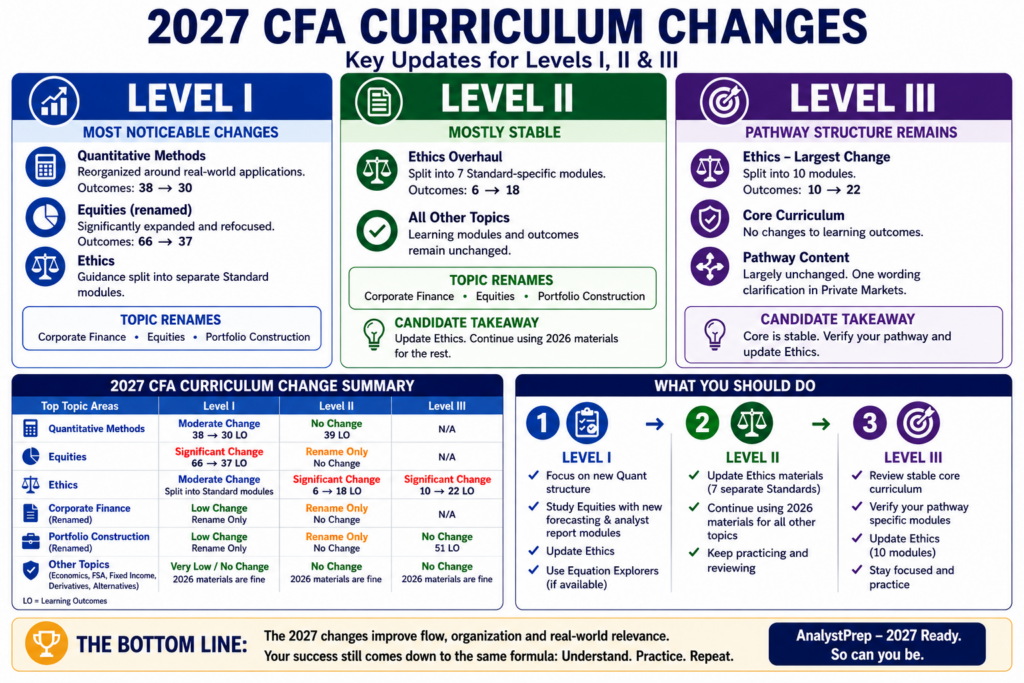
Level I received the most significant structural changes, especially in Quantitative Methods and Equities. Level II is mostly stable, with Ethics as the main headline. Level III keeps its pathway structure front and center while the core curriculum remains largely unchanged.
Let us take a close look at what changed, what did not and how this affects your preparation.
Before we break down each level, let us give you the high-level takeaways that actually matter to your study plan.
Level I received the most noticeable changes. Quantitative Methods has been reorganized around real-world applications. Equities has been renamed and significantly expanded. Ethics has been split into separate modules for each Standard.
Level II is mostly stable. The most visible update is a topic rename from Corporate Issuers to Corporate Finance, from Equity Valuation to Equities and from Portfolio Management to Portfolio Construction. The biggest structural change is in Ethics, which moved from one combined guidance module to seven separate Standard modules.
Level III keeps its pathway structure. The common core topics, like Asset Allocation and Portfolio Construction, are stable. Nevertheless, Ethics changed more at Level III than at any other level. It grew from 4 learning modules to 10.
Now, let us break this down level by level so you know exactly where to focus.
Level I received the most noticeable restructuring of all three levels. If you are taking Level I in 2027, pay close attention to Quantitative Methods and Equities.
Quantitative Methods, Less Memorization and More Application
The 2027 Quant curriculum has been reorganized around practical applications. You will find more Q&A, more knowledge checks and targeted examples throughout the material.
Here is what changed specifically. In 2026, Quantitative Methods had 11 learning modules and 38 learning outcomes. In 2027, it still has 11 learning modules but only 30 learning outcomes. That is a reduction of 8 learning outcomes. The CFA Institute removed several overlapping return calculations.
The standalone Hypothesis Testing learning module from 2026 has been deleted. Its content has been folded into a broader Estimation and Hypothesis Testing module. The Parametric and Non-Parametric Tests of Independence module has also been removed entirely.
On the new side, you will see a much clearer structure for returns. The 2026 module called Rates and Returns has been replaced with three new modules. They are Returns of Financial Assets and Instruments, Types of Financial Returns and Benchmarking Returns.
But the most exciting addition is something called Equation Explorers. These are interactive lessons available exclusively in the CFA Institute online learning ecosystem. You can adjust key values like discount rates or cash flows and watch dynamic tables and graphs update in real time. They accompany the Time Value of Money lessons. Instead of memorizing formulas, you can actually see how variables relate to each other. That is a genuine improvement.
Equities, Renamed and Reframed
Equity Investments is now simply called Equities. But the change goes far deeper than a name.
In 2026, the Equities topic had 8 learning modules and 66 learning outcomes. In 2027, it has 12 learning modules but only 37 learning outcomes. That sounds like a massive reduction but what actually happened is that the content has been consolidated and reorganized around practical applications.
The new curriculum grounds equity valuation in financial statement forecasting. You will learn to build disaggregated models that separately project revenue, margins, investment and financing. Scenario analysis with probability weighting has been introduced as standard valuation practice, not an afterthought.
Industry and company analysis received expanded treatment. Porter’s Five Forces and PESTLE are now explicitly connected to valuation narratives rather than treated as standalone frameworks.
There are also brand-new modules. One covers equity analyst research reports, including initiating coverage, the difference between sell-side and buy-side research and even activist short sellers. Another covers the practical application of the Capital Asset Pricing Model and multi-factor models for estimating the cost of equity using real market data.
The real-world examples now span airlines, pharmaceuticals, technology, consumer goods and utilities. This is not just theory. This is how real equity analysts work.
Topic Renames at Level I
Three topics have new names. Corporate Issuers has been renamed to Corporate Finance. Equity Investments has been renamed to Equities. Portfolio Management has been renamed to Portfolio Construction.
These are structural and organizational improvements rather than entirely new concepts. Do not panic. Your existing knowledge in these areas remains valuable.
Stable Areas at Level I
Economics, Financial Statement Analysis, Fixed Income, Derivatives and Alternative Investments remain largely unchanged. If you have started studying using 2026 materials, your work in these areas is still highly relevant.
Level I Summary
Here is a quick summary of changes by topic.
Quantitative Methods saw a moderate structural change. The learning outcomes decreased from 38 to 30. New Equation Explorers have been introduced. You should focus on the new module structure and the consolidated hypothesis testing content.
Equities saw significant changes. Learning outcomes decreased from 66 to 37 through consolidation. New modules have been added for forecasting, analyst reports and factor models. You need updated materials for this topic.
Ethics saw a moderate structural change. The guidance has been split into separate Standard modules. You can use 2026 materials for core principles but should update for the new module organization.
Corporate Finance and Portfolio Construction saw low changes. The content is mostly the same. Only the topic names have changed.
All other topics, including Economics, FSA, Fixed Income, Derivatives and Alternative Investments saw very low or no changes. Your 2026 materials are fine here.
If you are a Level II candidate, you can breathe easier. Level II is mostly stable.
The most visible updates are topic name changes rather than major content revisions. Corporate Issuers has been renamed to Corporate Finance. Equity Valuation has been renamed to Equities. Portfolio Management has been renamed to Portfolio Construction.
The Ethics Overhaul at Level II
The most meaningful structural change at Level II is in Ethics. Here is the comparison.
In 2026, Level II Ethics had 3 learning modules and only 6 learning outcomes. The guidance for Standards I through VII was all lumped into one single learning module.
In 2027, Level II Ethics has 9 learning modules and 18 learning outcomes. Each Standard from I to VII now has its own dedicated module with targeted practice problems. The Code of Ethics and the Application module remain.
What does this mean for you? Each Standard, including Professionalism, Integrity of Capital Markets, Duties to Clients, Duties to Employers, Investment Analysis Recommendations and Actions, Conflicts of Interest and Responsibilities as a CFA Institute Member or Candidate, now has its own space. This mirrors the updated Standards of Practice Handbook version 12 and makes studying Ethics much more navigable.
What Did Not Change at Level II
Virtually everything else remained unchanged. Quantitative Methods has 7 learning modules and 39 learning outcomes, identical to 2026. Economics has 2 learning modules and 25 learning outcomes, unchanged. Financial Statement Analysis has 6 learning modules and 42 learning outcomes, unchanged. Fixed Income has 5 learning modules and 50 learning outcomes, unchanged. Derivatives has 2 learning modules and 21 learning outcomes, unchanged. Alternative Investments has 4 learning modules and 29 learning outcomes, unchanged. Portfolio Construction has 6 learning modules and 52 learning outcomes, unchanged except for the topic rename.
Here is our candid advice.
If you are preparing for Level II with 2026 materials, you can continue with confidence. The only topic where you should update to 2027-specific materials is Ethics. For the remaining topics, your existing prep is still highly valid.
Level III remains built around its pathway structure. You choose between the Portfolio Management Pathway, the Private Markets Pathway, or the Private Wealth Pathway. The common core is stable but you must pay attention to your chosen pathway.
Core Curriculum, Largely Stable
The following core topics show no changes to Learning Outcomes from 2026 to 2027. Asset Allocation has 5 learning modules and 48 learning outcomes, unchanged. Portfolio Construction has 7 learning modules and 51 learning outcomes, unchanged. Performance Measurement has 3 learning modules and 37 learning outcomes, unchanged. Derivatives and Risk Management has 3 learning modules and 25 learning outcomes, unchanged.
The Ethics Change at Level III, Largest of All Levels
Do not overlook this. Level III Ethics changed more than Level II Ethics in absolute terms.
In 2026, Level III Ethics had 4 learning modules and only 10 learning outcomes. In 2027, Level III Ethics has 10 learning modules and 22 learning outcomes. The previously combined guidance module has been split into separate Standard I through VII modules, just like at Level II. The Asset Manager Code remains as learning module 10 of 10.
This is a 120 percent increase in learning outcomes for Ethics at Level III. The content is not necessarily harder. It is better organized and more practice-rich. But you must study it in its new structure. Do not rely on 2026 Ethics materials for Level III.
Pathway Specific Changes
Most pathway-specific learning modules are unchanged. The Portfolio Management Pathway has 8 learning modules and 64 learning outcomes, unchanged from 2026. The Private Wealth Pathway has 7 learning modules and 27 learning outcomes, unchanged.
The Private Markets Pathway has 7 learning modules and 34 learning outcomes. One learning outcome received a wording change. In the Private Debt module, the learning outcome regarding mezzanine debt and unitranche debt has been clarified. The core concept was retained, but the wording changed slightly.
For all other pathway modules, the learning outcomes are identical to 2026.
Here is our candid advice for Level III candidates. Review the common core first. It is stable. Then focus carefully on the learning modules specific to your chosen pathway. Do not assume your pathway changed just because the Ethics section did. But do not ignore Ethics either.
This is the question every candidate asks. Let me give you a candid assessment.
Level I saw moderate to significant change. Quantitative Methods has been restructured. Equities has been overhauled with a 66 to 37 learning outcome reduction and new modules on forecasting and analyst reports. Ethics has been split. Topic names have changed. Level I candidates need updated materials for Quant, Equities and Ethics.
Level II saw mostly stable conditions. The Ethics split is the main event. Otherwise, there is high continuity. Level II candidates can use 2026 materials for most topics but should update Ethics.
Level III saw pathway-dependent changes. The core curriculum is stable. Ethics expanded significantly from 4 to 10 modules and 10 to 22 learning outcomes. Pathway content is largely unchanged. Level III candidates should update Ethics and verify their specific pathway modules.
If you forced us to rank them, Level I changed the most, then Level III driven by Ethics, then Level II.
Let us be honest. No, you should not worry.
Here is why.
To begin with, this is not a complete overhaul. Foundational concepts like time value of money, financial statement analysis, asset pricing and ethics principles remain exactly where they belong. The exam is still the CFA exam.
Besides, most changes improve flow and organization. The new Ethics module structure, the Equation Explorers and the Equities forecasting emphasis all make the curriculum more logical and more practical. These are improvements, not obstacles.
There is something else. The CFA Institute is responding to candidate feedback. More practice problems, clearer navigation and real-world examples are things candidates have asked for. The Institute listened.
Lastly, and most importantly, your preparation habits still matter more than curriculum changes. Consistent study, active recall and thousands of practice questions remain the winning formula. No curriculum change changes that.
Here is what you should do differently.
If you are a Level I candidate, prioritize the new Quant and Equities structure. Use the Equation Explorers if you have CFA Institute access. Supplement with a question bank that tests application, not just recall. You need updated materials for Quant, Equities and Ethics.
If you are a Level II candidate, update your Ethics materials. The rest of your 2026 prep is still highly valid. Do not throw away good work.
If you are a Level III candidate, double-check your pathway-specific learning outcomes. The core is stable. Ethics needs fresh attention but your pathway content is largely fine.
We do not wait until exam day to update our materials. Our team has already mapped every 2027 learning outcome change across all three levels. We are already updating our question bank to reflect the new module structures, especially in Quantitative Methods, Equities and Ethics. We are aligning our performance tracking with the revised learning outcome weights. Finally, we are preparing pathway-specific content for Level III candidates.
You do not need to figure this out alone.
See the Changes for Yourself
See exactly how the 2027 changes affect your study plan. Try our free trial and compare the updated curriculum against our materials.
Compare the 2027 curriculum updates with our CFA Free Trial
The 2027 CFA curriculum changes are real. Level I candidates will feel them the most. But they are improvements, not traps. Whether you are sitting in 2026 or 2027, the best strategy remains the same. Understand the concepts. Practice relentlessly. Trust a preparation provider that respects your time.
At AnalystPrep, we have been doing this for over a decade. We are already 2027-ready.
The question is, are you ready?
Start your 2027 CFA preparation today
Access updated CFA study notes, practice questions, video lessons, and mock exams to prepare across Levels I, II, and III with the latest curriculum changes in mind.
Offered by AnalystPrep






If your CFA Level 1 August 2026 exam is only a few days... Read More

Let’s face it! The CFA exam is daunting. But there’s a silver lining—the... Read More
Get Ahead on Your Study Prep This Cyber Monday! Save 35% on all CFA® and FRM® Unlimited Packages. Use code CYBERMONDAY at checkout. Offer ends Dec 1st.