


Which CFA® Events in August 2026 Are ...
If you’re part of the CFA community, August 2026 is about much more... Read More

The final month before the CFA exam is where most candidates quietly sabotage themselves. Not because they suddenly stop caring but because their study habits change in ways that feel productive but are not.
By this stage, most candidates already know a large part of the curriculum. But the problem is not knowledge. The problem is execution.
By the final month, the issue is rarely intelligence. It is execution.
Instead of sharpening exam skills, many candidates shift into passive review. They reread notes, rewatch lectures and feel like they are preparing. In reality, they are avoiding real exam practice.
Most candidates do not fail because they are not smart. They fail because they study passively, avoid weak areas, skip mocks, ignore Ethics and manage the final month poorly. These are some of the most common CFA exam mistakes and they explain why CFA candidates fail again and again.
One of the biggest reasons why CFA candidates fail is passive studying habits.
Many candidates spend hours watching videos, rereading notes and highlighting summaries. It feels productive but it does not build exam skill.
Watching lectures is not preparation. CFA is not about recognition. It is about application.
A simple way to understand this is to think about the gym. Watching someone lift weights does not build muscle. In the same way, watching solutions does not build exam performance.
Passive studying CFA creates an illusion of competence. You feel like you understand the material because it looks familiar. But familiarity is not mastery.
The CFA exam rewards recall, not recognition. It rewards problem-solving under time pressure.
This is one of the most dangerous CFA exam mistakes. It feels safe but it does not prepare you for the real test.
Another key reason why candidates fail CFA Level 2 is how they handle mistakes.
Most candidates take mock exams, check their scores and move on.
Candidates who pass do the opposite. They focus deeply on errors.
Every mistake tells a story. It shows weak concepts, poor judgment or gaps in understanding.
A strong approach includes keeping an error log. You record mistakes, group them into categories and review them repeatedly. Over time, patterns become clear.
Your weakest patterns matter more than your strongest topics.
This is one of the most overlooked CFA revision mistakes. Candidates spend time repeating what they already know instead of fixing what they consistently miss.
A major reason why people fail CFA is low question practice.
Many candidates believe understanding the material is enough. It is not.
Understanding a concept is different from applying it in a vignette under time pressure.
CFA Level 2 is especially application-heavy. It tests how you think, not what you remember.
Many candidates avoid questions because questions expose weaknesses. Reading feels comfortable. Questions feel uncomfortable.
But that discomfort is the point.
High question practice improves speed, accuracy and pattern recognition. It reduces surprises on exam day.
This is one of the most important CFA exam mistakes. If you are not doing enough questions, you are not preparing for the CFA exam. You are only studying it.
Ethics is one of the most underestimated areas in CFA preparation.
Many candidates assume Ethics is easy because it feels familiar and theoretical.
This is misleading.
Ethics questions are not about definitions. They are about judgment in complex situations.
Ethics becomes difficult because the scenarios are subtle. Small details change the correct answer.
Ethics is also cumulative and often decisive in borderline results.
Ethics is not difficult because the concepts are hard. It is difficult because the situations are complex.
Ignoring CFA ethics preparation until the final weeks is one of the most common CFA exam mistakes.
The final month often changes behavior in negative ways.
Many candidates abandon their original study plan. They jump between topics, revise randomly and lose structure.
Some spend too much time on forums or stress discussions instead of studying.
This is where panic replaces discipline.
Instead of following a clear system, they become reactive. They study what feels urgent instead of what is important.
This is a major reason why CFA candidates fail. It’s not because they lack knowledge but because they lose consistency.
CFA mock exams are one of the most powerful tools in preparation. But many candidates use them the wrong way.
Most candidates treat mocks as a score report. They take a test, check the result and move on.
Passing candidates use mocks as learning tools.
The value of a mock exam is not the score. It is the review process afterward.
Mocks help identify weak areas, improve timing and build exam stamina.
Every mock should be followed by deep analysis. You should study why mistakes happened and how to avoid them.
Ignoring this process leads to repeated CFA mock exam mistakes.
If you are not learning from your mocks, you are not improving from them.
Burnout is one of the most common final month problems.
Many candidates increase study hours, reduce sleep and push themselves harder.
This often backfires.
Stress builds over time. The more they study, the more behind they feel. The more behind they feel, the more they study.
Eventually, consistency breaks.
Burnout is not caused by weakness. It is caused by unsustainable effort combined with anxiety.
One of the hidden CFA revision mistakes is ignoring rest. Without recovery, retention and performance drop.
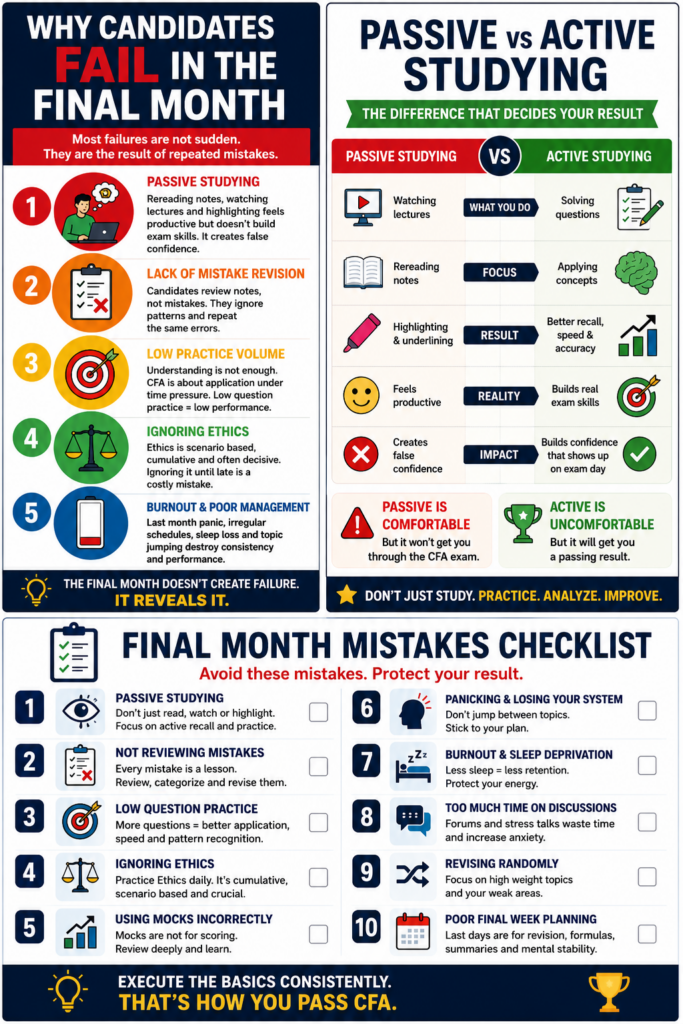
Candidates who pass are not extraordinary. They are more consistent.
They focus on question practice instead of passive review. They learn from mistakes instead of ignoring them. They revise repeatedly instead of switching topics constantly.
They stay consistent even when motivation drops. They do not avoid difficult areas.
Most importantly, they stay active in their learning.
This is a key part of how to avoid failing CFA exams. Success is not about knowing everything. It is about executing the basics well.
A simple structure can improve performance in the final month.
In the first two weeks, focus on diagnostic mocks. Identify weak areas and target them with focused practice.
In the next phase, shift to revision of high-weight topics. Practice Ethics daily and work through timed item sets.
In the final days, reduce intensity. Focus on formulas, summaries and light review. Prioritize sleep and mental stability.
The goal is not to relearn everything. The goal is to sharpen performance.
Most CFA failures are predictable weeks before the exam.
The signs are usually visible. Low practice volume. Skipped topics. Weak Ethics preparation. Random revision. Growing burnout.
These are not sudden failures. They are the result of repeated choices.
This is the uncomfortable truth behind why people fail CFA exams. It is rarely about intelligence. It is about execution in the final month.
The final month does not create failure. It reveals it.
Why CFA Candidates Fail
CFA candidates fail mainly due to passive studying CFA habits, low question practice, poor mock exam review and weak final month execution.
Why People Fail CFA
People fail CFA because they rely on reading and watching content instead of active practice and mistake correction.
Why Candidates Fail CFA Level 2
Candidates fail CFA Level 2 mainly due to weak vignette practice, poor application skills and insufficient CFA revision mistakes correction.
Common CFA Mistakes
Common CFA mistakes include passive studying CFA, skipping Ethics, low question volume, and ignoring mock exam review.
CFA Exam Mistakes
CFA exam mistakes often include poor time management, lack of practice under exam conditions and failure to review weak areas.
CFA Ethics Preparation
CFA ethics preparation should be continuous because Ethics questions are scenario-based and require careful judgment under pressure.
How To Avoid Failing CFA
To avoid failing CFA, focus on active question practice, structured revision, mock exam review and consistent improvement of weak areas.
Access structured study notes, practice questions, and mock exams to strengthen your CFA knowledge and improve your exam readiness in the final month.
Offered by AnalystPrep






If you’re part of the CFA community, August 2026 is about much more... Read More

You’re counted lucky if you’ve discovered the value embedded in the CFA qualification.... Read More

Get Ahead on Your Study Prep This Cyber Monday! Save 35% on all CFA® and FRM® Unlimited Packages. Use code CYBERMONDAY at checkout. Offer ends Dec 1st.
