





CFA® Level I IBF-STS Funding in Singa ...
Imagine registering for the CFA Level I exam and knowing that if you... Read More

Passing CFA Level II is not just about how many hours you study. It is about where those hours go.
That is what surprises many candidates.
At Level I, broad familiarity with the curriculum can sometimes help you survive the exam. Level II is very different. The exam is deeper, more connected and far more application-based. You are no longer answering isolated questions. You are working through long vignette sets where one weak area can hurt your score across several questions.
That is why topic prioritization matters so much.
Most candidates preparing for the exam are dealing with the same challenge. Limited revision time. Mental fatigue. Growing uncertainty about what deserves the most attention. Somewhere along the way, almost every candidate asks the same question.
“What topics can I absolutely not afford to ignore?”
That question becomes even more important after spending time in CFA candidate communities. Reddit discussions, LinkedIn conversations and post-exam reflections all point to the same reality. Some topics consistently dominate candidate anxiety and exam outcomes.
You repeatedly hear comments like:
These reactions are not random.
Some sections appear more consistently on the exam. Some areas are structurally harder. Some topics expose weak conceptual foundations immediately. And some topics repeatedly separate candidates who pass from candidates who fail.
Still, there is one very important piece of information here.
The most tested CFA Level 2 topics are not the only topics that matter.
That clarification is critical.
Strategic prioritization is smart. Strategic neglect is dangerous.
The candidates who perform well usually understand both truths at the same time.
One of the biggest mistakes candidates make is assuming all topics contribute equally to exam performance.
They do not.
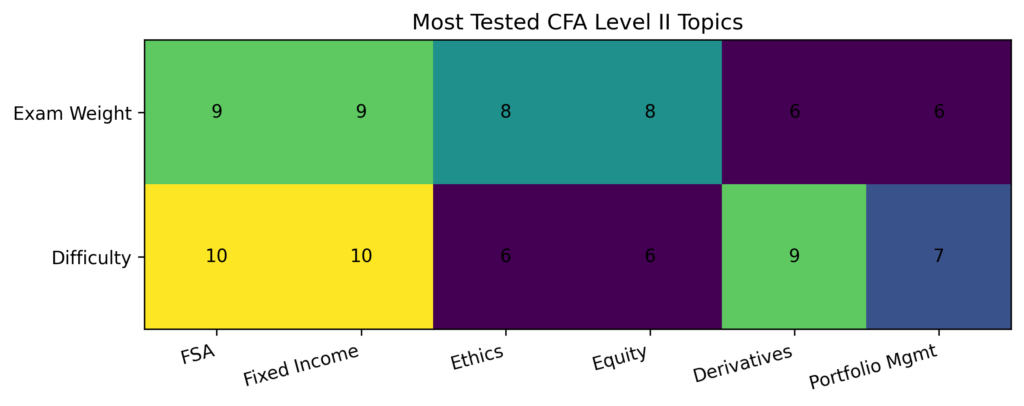
The CFA Level 2 topic weight structure naturally gives some sections more influence over your final score. Higher-weight topics create more item sets, more questions and more opportunities to gain or lose points.
But weighting alone is not what makes some sections so difficult.
The real challenge comes from how Level II tests concepts.
The exam is heavily vignette-based. You are expected to combine information, apply technical concepts and interpret details under time pressure. This creates an environment where conceptual weaknesses become very visible very quickly.
That is why some sections feel disproportionately difficult even when their weightings are not the highest.
Certain readings are deeply connected. Others rely heavily on knowledge from Level I. Some topics involve long calculations, accounting adjustments or valuation assumptions that mentally drain candidates before they even finish the vignette.
This is why the hardest CFA Level 2 topics often overlap with the most heavily tested ones.
At the same time, candidates should avoid oversimplifying their preparation strategy.
High-weight topics deserve more attention. But Level II punishes weak conceptual gaps across the curriculum.
The strongest candidates understand this balance. They allocate study time strategically without creating dangerous gaps in coverage.
The Section That Breaks Most Candidates
Among all CFA Level 2 important topics, Financial Statement Analysis sits near the top of almost every candidate’s fear list.
And it’s for good reason.
FSA at Level II feels completely different from what many candidates experienced previously. The material becomes denser, more technical and far more mentally exhausting. Candidates frequently describe the experience using phrases like “head spinning,” “technical overload” and “getting thrown into the deep end.”
That emotional reaction is understandable.
The section forces you to process complicated accounting relationships while navigating detailed vignettes under time pressure. Weak foundational knowledge becomes brutally exposed here.
Topics like intercorporate investments, multinational operations, pensions, share-based compensation and financial institutions create layers of complexity that overwhelm many candidates initially.
This is also why CFA Level 2 FSA consistently ranks among the hardest CFA Level 2 topics.
Unlike some sections where memorization can temporarily hide weaknesses, FSA demands genuine conceptual understanding. If your accounting foundation is shaky, the difficulty compounds rapidly.
Candidates often underestimate how cumulative this section is. One misunderstanding early in a vignette can distort your interpretation of everything that follows.
That is why repeated practice matters so much here.
Reading the curriculum alone is rarely enough. Candidates who improve in FSA usually spend significant time drilling targeted question banks, reviewing item sets repeatedly and exposing themselves to different vignette structures until pattern recognition starts developing naturally.
One encouraging reality is that improvement in FSA tends to compound over time. Concepts that initially feel impossible gradually become manageable once enough repetition occurs.
That process simply requires patience and deliberate practice.
Strengthen the most heavily tested CFA Level II topics with realistic item-set practice, targeted QBank drilling and repeated vignette exposure through AnalystPrep.
The Most Dangerous Topic at Level II
If there is one section candidates consistently describe as make-or-break, it is Fixed Income.
The anxiety surrounding CFA Level 2 fixed income is not exaggerated.
This topic combines high weighting with significant technical difficulty, which makes it one of the most dangerous sections on the entire exam.
The challenge begins with how interconnected the material feels. Concepts build aggressively on one another and if you lose clarity on one reading, the confusion often spills into the next.
Candidates frequently struggle with:
Then the vignette structure intensifies everything further.
Long calculations, layered assumptions and detailed interpretation create an environment where small mistakes quickly snowball into larger scoring problems.
This explains why Fixed Income consistently appears in discussions about the most tested CFA Level 2 topics and the hardest CFA Level 2 section.
More importantly, strong performance here appears closely connected to passing outcomes overall.
Candidates who perform well in Fixed Income are often far more likely to pass the exam than those who don’t.
That psychological reality matters.
Many candidates try to avoid the discomfort this section creates. Unfortunately, avoidance usually makes the problem worse. Fixed Income tends to reward consistent exposure rather than occasional review sessions.
The encouraging part is that familiarity changes everything.
Initially, the readings can feel impossibly abstract. But repeated item-set practice gradually reduces the intimidation factor. Concepts that once seemed disconnected begin fitting together more naturally.
The turning point usually comes when candidates stop trying to memorize formulas mechanically and instead start understanding the intuition behind interest rate behavior, bond valuation and credit risk relationships.
That shift often transforms Fixed Income from a panic-inducing topic into a major scoring opportunity.
The Silent Score Multiplier
Many candidates walk into Level II assuming Ethics will feel similar to Level I.
That assumption can become expensive.
While CFA Level 2 ethics still tests the same Standards of Professional Conduct, the vignette structure makes the application significantly more complex. The questions become less direct. The distinctions become subtler. And the pressure of interpreting long scenarios increases the likelihood of second-guessing yourself.
This is one reason candidates often underestimate Ethics during preparation.
Because they have “seen it before,” they assume it requires less attention.
That is dangerous thinking.
Ethics appears on every exam, carries meaningful CFA Level 2 topic weight and may play a role near the minimum passing score when candidate performance is borderline.
In practical terms, Ethics can quietly become a score multiplier.
One of the most important things candidates discover is that Ethics rewards repetition more than cramming. The candidates who perform best usually develop familiarity through constant exposure rather than isolated study sessions.
Daily ethics questions help enormously.
So does repeated vignette practice.
Over time, pattern recognition starts developing naturally. Candidates become better at identifying subtle wording traps, conflicts of interest and disclosure issues without overcomplicating the scenario.
That gradual familiarity often produces significant score improvement close to exam day.
One of the Highest ROI Sections
Among the CFA Level 2 high-yield topics, Equity Valuation often delivers one of the best returns on study time invested.
That does not mean the section is easy.
Initially, many candidates find the valuation models intimidating. Dividend discount models, FCFF, FCFE, residual income models and valuation multiples can feel overwhelming when encountered all at once.
But there is an important psychological difference compared to sections like FSA or Fixed Income.
For many candidates, Equity eventually starts feeling natural.
This pattern appears repeatedly across candidate discussions. The topic often feels difficult at first, then becomes highly manageable after enough targeted practice.
That predictability matters enormously during revision.
Candidates who spend time mastering valuation frameworks often discover that Equity questions become increasingly recognizable. Common patterns emerge. The logic behind assumptions becomes clearer. The calculations become faster.
This is why Equity remains one of the highest ROI sections within the best CFA Level 2 study strategy.
The section also rewards conceptual understanding strongly. Candidates who understand why valuation models behave differently under different assumptions usually perform far better than candidates attempting to memorize formulas mechanically.
Another advantage is confidence-building.
Once candidates start consistently solving Equity item sets correctly, the psychological momentum can positively influence performance in other difficult areas as well.
The Topic Candidates Fear Most
Very few Level II topics generate as much anxiety as Derivatives.
Even strong candidates frequently describe the section as intimidating, confusing or mentally exhausting.
The fear usually begins with the formulas.
Many instruments appear similar on the surface. Swaps, forwards, options and contingent claims often involve overlapping terminology and related valuation concepts. Under exam pressure, candidates can easily mix frameworks together.
Then the vignette format amplifies the confusion.
Long scenarios, layered assumptions and dense calculations create an environment where even candidates who understand the material conceptually may struggle initially.
This is why CFA Level 2 derivatives consistently ranks among the hardest CFA Level 2 topics.
But there is also good news here.
Derivatives tends to improve dramatically with repeated question exposure.
That pattern shows up constantly in candidate experiences. What initially feels abstract slowly becomes manageable after enough item-set repetition. Candidates begin recognizing recurring structures, common traps and familiar valuation patterns.
The breakthrough usually happens when the topic stops feeling like isolated formulas and starts feeling like a connected system.
At that point, confidence rises quickly.
This is one reason candidates should resist abandoning Derivatives too early during preparation. The learning curve can feel brutal initially, but improvement is often much faster than expected once consistent practice begins.
Portfolio Management rarely receives the same level of fear-driven attention as FSA, Fixed Income or Derivatives.
That is exactly why it becomes dangerous.
Many candidates unconsciously downgrade its importance during preparation because the section feels less intimidating at first glance. Unfortunately, that underestimation can become costly.
Portfolio Management is highly integrated, conceptually rich and increasingly important for Level III.
The section tests how well candidates connect ideas across the curriculum rather than simply memorizing isolated formulas. Risk management, asset allocation, performance evaluation and portfolio construction often require deeper interpretation than candidates initially expect.
This creates an interesting dynamic.
Candidates who neglect Portfolio Management frequently realize too late that the questions demand more analytical depth than anticipated.
The topic also benefits significantly from repeated vignette exposure. Candidates who practice enough item sets usually become far more comfortable identifying the underlying logic connecting different portfolio decisions and risk considerations.
In many ways, Portfolio Management represents the transition toward the type of thinking heavily emphasized later in the CFA Program.
That is why treating it as a secondary afterthought can become a strategic mistake.
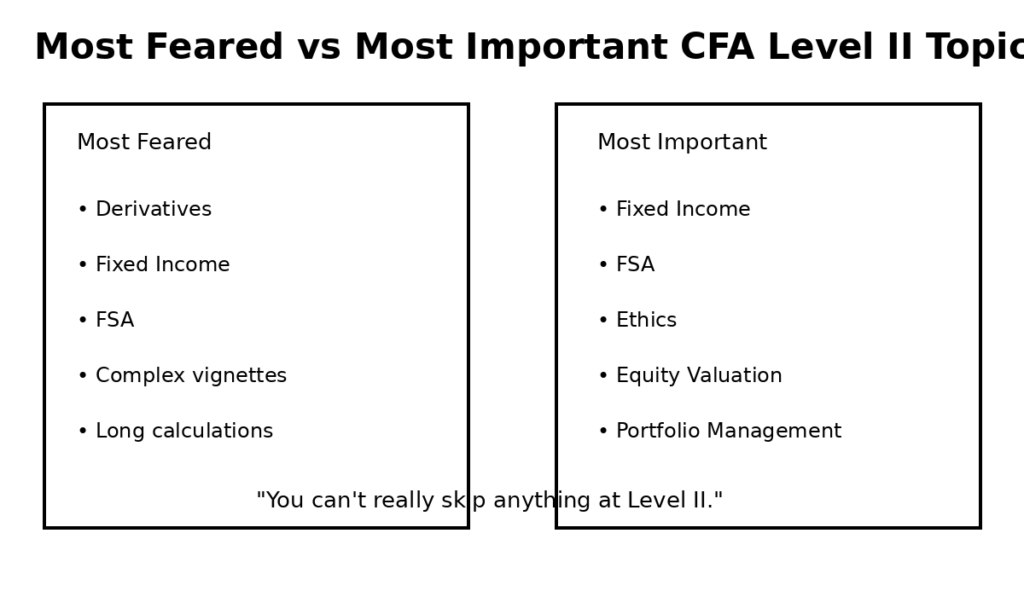
This debate appears constantly among CFA candidates.
Should you skip low-weight topics to focus more heavily on major sections?
The honest answer requires detail.
Strategic prioritization is smart. Strategic neglect is dangerous.
That distinction matters enormously at Level II.
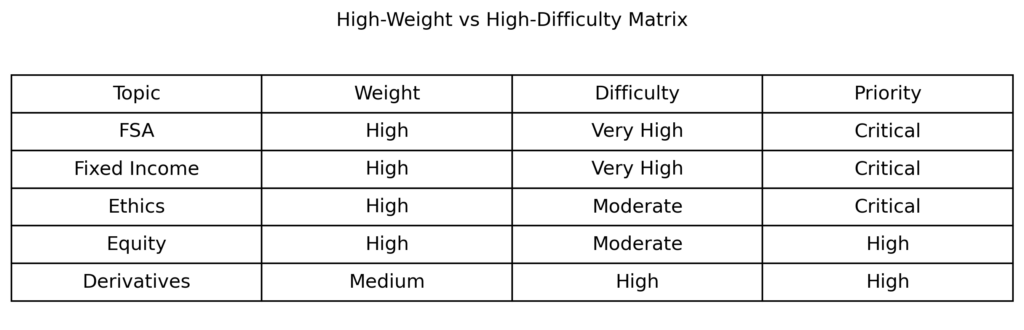
Yes, some lower-weight topics naturally deserve less revision time compared to major sections like FSA, Fixed Income, Ethics and Equity. That is simply rational allocation of limited study hours.
But completely abandoning topics introduces meaningful risk.
The Level II item-set structure can punish isolated weaknesses severely. A single difficult vignette from a neglected section may suddenly cost an entire block of points.
More importantly, candidates often underestimate how interconnected the curriculum becomes. Concepts from supposedly “smaller” topics frequently support understanding elsewhere.
This is why many candidates later regret aggressive topic-skipping strategies.
The better approach is usually proportional preparation rather than complete avoidance.
Lower-weight topics may not require identical depth of mastery but they still deserve enough coverage to prevent catastrophic scoring gaps on exam day.
As the exam approaches, candidates need a revision strategy that balances weighting, difficulty and personal strengths realistically.
A useful framework looks something like this.
Tier 1 Priority
These areas combine high weighting with significant scoring influence. For most candidates, they deserve the largest share of revision time and question practice.
Tier 2 Priority
These sections are often underestimated or feared. Strong preparation here mostly creates meaningful score separation.
Tier 3 Priority
These topics still matter, but revision intensity can be adjusted depending on background and confidence level.
That final point is extremely important.
An accounting professional may require less FSA review than an engineering graduate. A candidate with strong quantitative skills may allocate revision differently than someone who struggles with statistics.
The best CFA Level 2 study strategy is never completely generic.
Weighting matters. Personal strengths matter too.
The strongest preparation plans account for both realities simultaneously.
Candidates who pass Level II consistently tend to approach preparation differently from candidates who narrowly miss the mark.
The difference is rarely intelligence alone.
Instead, successful candidates usually develop better feedback systems during revision.
They practice aggressively.
They revisit weak areas repeatedly.
They maintain error logs.
They review incorrect answers carefully rather than rushing toward completion metrics.
Most importantly, they spend significant time working through item sets under realistic conditions.
That last point cannot be overstated.
Level II is fundamentally an application exam. Passive reading creates familiarity. Active problem-solving creates exam readiness.
Passing candidates also tend to become highly targeted during the final weeks before the exam. Instead of trying to reread everything equally, they identify recurring weak spots and attack them systematically.
That is where high-quality analytics, realistic mocks and topic-specific question banks become extremely valuable.
CFA Level II is not about covering everything equally. It is about mastering the topics that repeatedly decide exam outcomes.
Candidates looking to strengthen weak areas, improve vignette performance and build realistic exam readiness can explore targeted practice resources, analytics-driven QBank sessions and full-length mock exams through AnalystPrep CFA Level II Resources.
What are the most tested CFA Level 2 topics?
Financial Statement Analysis, Fixed Income, Ethics and Equity Valuation are widely considered the most tested CFA Level 2 topics because of their weighting, technical depth and consistent presence in difficult vignette sets.
What are the CFA Level 2 high yield topics?
The CFA Level 2 high yield topics typically include FSA, Fixed Income, Ethics, Equity Valuation and Portfolio Management because these areas combine high topic weight with strong scoring impact.
What are the hardest CFA Level 2 topics?
Many candidates consider Fixed Income, Financial Statement Analysis and Derivatives the hardest CFA Level 2 topics because of their complexity, calculations and interconnected concepts.
What is the hardest CFA Level 2 section?
Fixed Income is often considered the hardest CFA Level 2 section because it combines high topic weight with difficult vignette-based calculations and valuation concepts.
Is CFA Level 2 Ethics harder than Level I?
Yes. CFA Level 2 ethics becomes more difficult because the vignette format introduces more nuanced interpretation and application challenges.
Can I skip low-weight topics at CFA Level II?
Completely skipping topics is risky. Strategic prioritization is reasonable, but isolated weaknesses can significantly hurt performance because of the item-set structure.
What is the best CFA Level 2 study strategy?
The best CFA Level 2 study strategy combines consistent question practice, targeted weak-topic revision, repeated vignette exposure and realistic mock exam preparation.
Why is CFA Level 2 Fixed Income considered so important?
CFA Level 2 fixed income combines high CFA Level 2 topic weight with significant technical difficulty. Strong performance in this section is often closely associated with passing outcomes.
Why do candidates struggle with CFA Level 2 FSA?
CFA Level 2 FSA is dense, cumulative and technically demanding. Weak accounting foundations often become exposed quickly during vignette-based questions.
Does Derivatives get easier with practice?
Yes. Many candidates initially find CFA Level 2 derivatives overwhelming, but repeated item-set exposure usually improves understanding significantly over time.
Master the most tested CFA Level II topics with comprehensive study notes, practice questions, mock exams, and learning tools designed to boost your exam readiness.
Offered by AnalystPrep






Imagine registering for the CFA Level I exam and knowing that if you... Read More

Last updated: September 30, 2026 A few weeks ago, the question was when... Read More
Get Ahead on Your Study Prep This Cyber Monday! Save 35% on all CFA® and FRM® Unlimited Packages. Use code CYBERMONDAY at checkout. Offer ends Dec 1st.
