


Collateralized Debt Obligations
Collateralized Debt Obligations (CDOs) are financial instruments issuing securities backed by diversified debt... Read More

A fixed-income security is a financial instrument that requires the issuer to make scheduled interest payments and repay the principal to investors according to predetermined terms. These securities include government bonds, corporate bonds, municipal bonds, and many other debt instruments.
Understanding the defining features of a fixed-income security helps investors evaluate risk, expected return, and the legal rights associated with a bond. These characteristics also determine how bonds are valued and traded in financial markets.
In this study note, you’ll learn:
Every fixed-income security has several defining characteristics that determine its cash flows, risk profile, and expected return.
The most important features include:
Together, these features allow investors to compare bonds and evaluate their suitability within an investment portfolio. (CFA Institute)
Fixed-income securities encompass bonds and loans, serving as crucial avenues of debt financing for corporations and governments. These are formed under standardized agreements, where issuers obtain funds for operational or capital needs, and investors, in turn, lend their capital, expecting interest payments and the eventual return of the principal. These securities are part of a broader spectrum of corporate liabilities, with each debt type possessing unique features such as varying maturities, seniority levels, and currencies.
Importantly, fixed-income securities are distinctive from other liabilities as they involve cash-settled agreements with investors or banks. Governments typically use bond issuance as their primary financing strategy, though some also secure loans from international bodies like the IMF. A distinguishing characteristic of fixed-income securities from equities is their guaranteed periodic cash flows, offering investors regular income and capital return upon maturity.
| Feature | What It Describes | Why It Matters |
| Issuer | Entity borrowing the funds | Determines credit quality |
| Maturity | Date principal is repaid | Influences interest rate risk |
| Principal | Amount repaid at maturity | Determines bond value |
| Coupon Rate | Interest paid to investors | Determines periodic cash flows |
| Seniority | Repayment priority | Affects recovery in default |
| Contingency Provisions | Embedded options | Can change future cash flows |
| Yield Measures | Expected investment return | Used to compare bonds |
Every fixed-income security is a contractual agreement between an issuer and investors.
Although two bonds may appear similar, differences in maturity, coupon structure, seniority, or embedded options can significantly affect their risk and expected return.
Understanding these characteristics allows investors to evaluate bonds more effectively and compare different securities across issuers and markets. (CFA Institute)
A bond’s issuer, whether it’s a national government, a local body, or a private corporation, is responsible for making all interest and principal payments. Sovereign bonds usually carry the least risk due to governmental backing.
This signifies the end date when the issuer completes its payments to bondholders. Securities with a maturity period of one year or less are considered money market securities, while those extending beyond a year are capital market securities. Perpetual bonds, which do not have a definite maturity, are also a unique class of bonds.
This is the amount that the issuer agrees to repay to investors at the end of the bond’s lifespan. Some securities may distribute principal repayment over time rather than in one lump sum at maturity.
Bond interest can be classified as fixed, variable, or part of a single payment at maturity. Fixed-coupon bonds involve regular payments at specific intervals (monthly, quarterly, semi-annual, or annual), with corporate bonds typically paying semiannually. Floating-rate notes (FRNs) have variable interest determined by combining a market reference rate (MRR) and a credit spread. Zero-coupon bonds, on the other hand, do not pay periodic interest; instead, they pay interest along with the principal at maturity and are usually issued at a discount to par value.
$$ \text{Interest expense} =\frac{\text{Par Value of the bond} \times \text{Coupon rate}}{\text{Frequency of payments}} $$
| Bond Type | Coupon Payments | Typical Characteristics |
| Fixed-Rate Bond | Fixed periodic payments | Predictable income |
| Floating-Rate Bond | Coupon adjusts with reference rates | Lower interest rate risk |
| Zero-Coupon Bond | No periodic coupons | Issued at a discount and repaid at par |
Consider two bonds issued by different companies.
Although both have the same maturity and principal, changes in market interest rates will affect their cash flows differently.
This example illustrates why understanding bond features is essential when comparing fixed-income investments.
In terms of repayment during liquidation or bankruptcy, senior debt takes precedence over other forms of debt. Junior or subordinated debts are repaid only after senior debts are settled.
Bonds may include clauses for actions under certain circumstances. A contingency provision in bonds includes embedded options like call, put, and conversion to equity. These options cannot be traded separately from the bond but can be valued by comparing it with a similar bond without such provisions.
Each bond feature influences investment decisions differently.
For example:
Professional investors evaluate these features together rather than in isolation when selecting fixed-income securities. (CFA Institute)
The bond’s expected cash flows and its price can be used to determine yield measures like current yield and yield-to-maturity.
$$ \text{Current yield} =\frac{\text{Annual coupon}}{\text{Bond price}}\times100\% $$
Yield-to-maturity (YTM) is a more complex measure, calculated as the internal rate of return using the bond’s price and its coupon payments until maturity. It is normally expressed as an annual rate. If all assumptions hold (no default, holding until maturity, reinvesting at YTM), the investor’s rate of return will equal the bond’s YTM at the time of purchase.
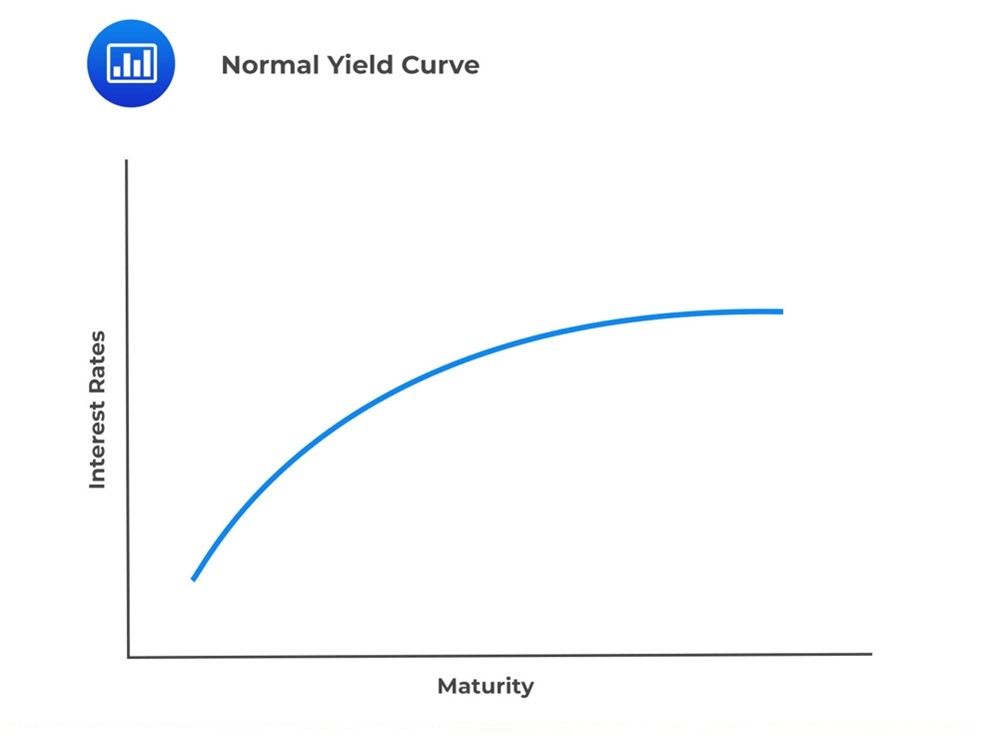
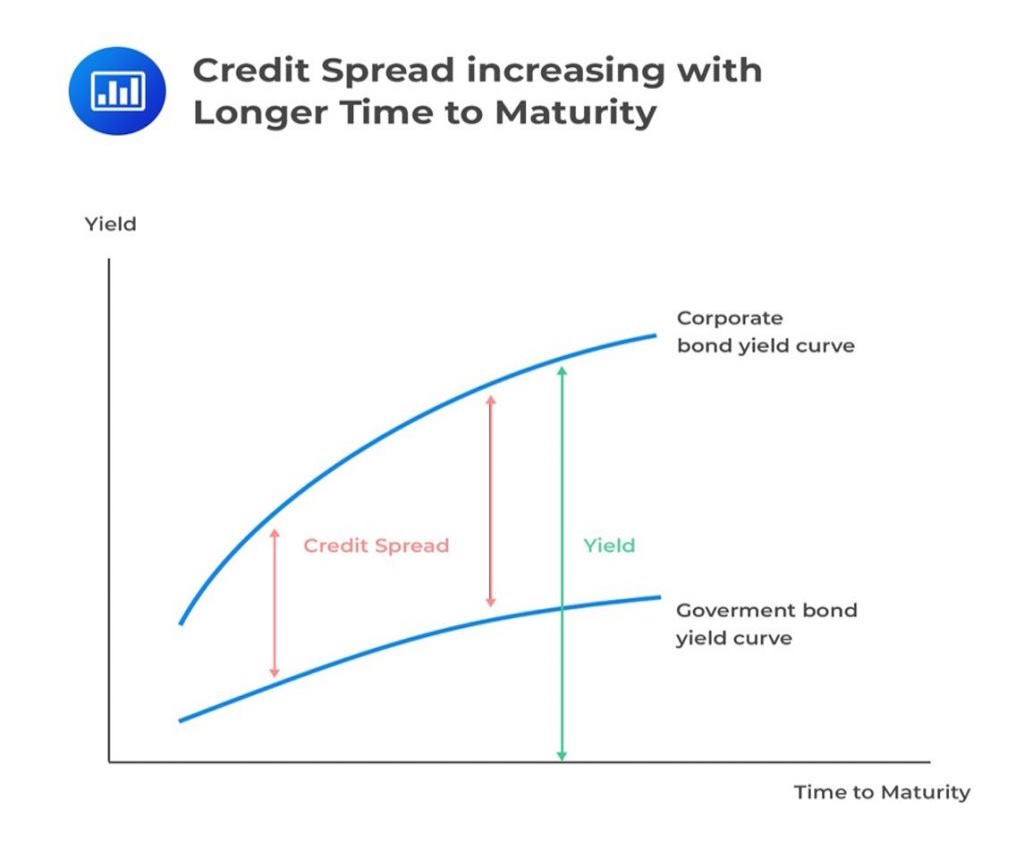
Plotting an issuer’s bonds against their yield-to-maturity and time-to-maturity gives us a yield curve. It is a useful tool for comparing the expected returns on different bonds issued by the same entity. Comparing this with the yield curve of a risk-free bond, like a sovereign bond, gives a measure of the credit risk of the bond.
This is demonstrated in the charts that follow.
The CFA Level I exam frequently asks candidates to identify the defining features of different bond types.
Be comfortable distinguishing:
Many conceptual questions test these distinctions rather than calculations.
The coupon payment on a 3% coupon bond with a par value of $200,000 and a quarterly payment frequency is closest to:
- $666.67
- $1500.00
- $24000.00
Solution
The correct answer is B.
$$ \begin{align*} \text{Coupon payment} & =\frac{\text{Par Value of the bond} \times \text{Coupon rate}}{\text{Frequency of payments}} \\
\text{Coupon payment} & =\frac{\$200,000 \times 3\%}{4}=\$1,500 \end{align*} $$Question 2
Consider a floating-rate note (FRN) with a notional value of USD 5 million, issued by a U.S. corporation. The FRN pays quarterly interest equal to the three-month market reference rate (MRR) plus 200 basis points (2.00%). If the current three-month MRR is 1.75%, the corporation’s quarterly coupon interest payable for this period is closest to:
- $46,875
- $87,500
- $187,500
Solution
The correct answer is A.
The FRN coupon consists of the MRR plus the issuer-specific spread.
$$ \begin{align*}
\text{FRN coupon} & = \text{MRR} + \text{Spread.} \\
\text{FRN coupon} & = 1.75\% + 2.00\%. \\
\text{FRN coupon} & = 3.75\%.
\end{align*} $$$$ \text{Annual interest} = \$5,000,000 \times 3.75\% = \$187,500 $$
So that that the quarterly interest is: \(\frac{\$187,500 }{4}=\$46,875\)
Bond Issuer — The entity that borrows money by issuing a bond.
Principal (Par Value) — The amount repaid to investors at maturity.
Coupon Rate — The annual interest rate paid on a bond’s par value.
Maturity — The date on which the bond’s principal is repaid.
Yield — The expected return earned from holding a bond.
Yield Curve — A graph showing the relationship between bond yields and maturities.
Seniority — The repayment priority of a bond if the issuer defaults.
Contingency Provision — An embedded feature that may alter future bond cash flows.
| Feature | Key Purpose |
| Issuer | Identifies who is responsible for repayment |
| Maturity | Determines repayment date |
| Principal | Specifies repayment amount |
| Coupon Rate | Determines periodic interest payments |
| Seniority | Establishes repayment priority |
| Contingency Provisions | May alter future cash flows |
| Yield Measures | Measure expected investment return |
Understanding these features enables investors to compare bonds, assess risk, and evaluate expected returns more effectively.
A fixed-income security is a debt instrument that promises scheduled interest payments and repayment of principal according to agreed terms.
The primary features include the issuer, maturity, principal, coupon rate, seniority, contingency provisions, and yield measures.
Maturity determines when investors receive their principal and influences a bond’s sensitivity to interest rate changes.
The coupon rate determines scheduled interest payments, while yield measures the investor’s expected rate of return based on the bond’s current market price.
Seniority determines the order in which bondholders are repaid if the issuer enters bankruptcy or liquidation.
Understanding bond characteristics is fundamental to bond valuation, pricing, yield analysis, and risk assessment throughout the CFA curriculum. (CFA Institute)






Get Ahead on Your Study Prep This Cyber Monday! Save 35% on all CFA® and FRM® Unlimited Packages. Use code CYBERMONDAY at checkout. Offer ends Dec 1st.