


Should You Finish Reading Before Pract ...
Many CFA candidates follow the same preparation routine: finish all the readings, watch... Read More
How many hours do you really need to study for the CFA exam? The commonly cited benchmark is 300 hours per examination level. CFA Institute reports that successful candidates spend more than 300 hours preparing for each level on average.
However, this does not mean every candidate must study exactly 300 hours or that completing those hours guarantees a passing result. Your preparation time depends on several factors, including your educational background, professional experience, familiarity with financial concepts and ability to understand and apply the curriculum.
For example, someone with a background in finance or accounting may already be familiar with some topics, while a candidate transitioning from an unrelated field may need additional time to build foundational knowledge.
The important distinction is between the number of hours you spend studying and how effectively you use them. In this guide, we’ll explore the 300-hour CFA study benchmark, what influences individual preparation time and how to build a realistic study schedule that helps you make the most of your available hours.
The 300-hour CFA study benchmark comes from CFA Institute, which reports that successful candidates spend more than 300 hours preparing for each examination level on average. This figure has become a widely used reference point for candidates planning their preparation timelines.
However, understanding what the number represents is important before using it to build your study schedule.
According to CFA Institute, successful candidates report spending more than 300 hours preparing for each level of the CFA exam on average. The institute also acknowledges that preparation time varies depending on candidates’ previous education and professional experience.
This means the 300-hour figure reflects the reported preparation habits of successful candidates rather than a fixed amount of time every candidate must spend studying.
The CFA Program covers a broad range of investment topics, including Ethics, Quantitative Methods, Financial Statement Analysis, Economics, Equity Investments and Fixed Income.
With so much material to cover, candidates need a practical way to estimate their preparation commitments. The 300-hour benchmark provides a useful starting point for deciding when to begin studying, how many hours to allocate each week and how much time to reserve for revision and mock examinations.
Preparation providers and study planners also use the figure to help candidates organize their examination preparation.
No. Completing 300 study hours does not guarantee that you will pass the CFA exam.
Two candidates can spend the same amount of time studying but achieve very different results. One may actively practise questions, review explanations and address knowledge gaps, while another spends most of that time passively reading familiar material.
Passing depends on your ability to understand the curriculum, recall important concepts, apply your knowledge and perform under examination conditions.
The 300-hour figure is an average reported by successful candidates, not a mandatory minimum or an official examination requirement.
Some candidates may need more time because they are unfamiliar with financial concepts or struggle with particular subjects. Others may find certain areas easier because of their academic or professional backgrounds.
Use the benchmark as a starting point when planning your preparation, then adjust your study schedule according to your progress and performance.
Not every CFA candidate starts with the same level of knowledge or experience. Some already understand financial concepts covered in the curriculum, while others need additional time to build foundational knowledge. Learning pace, available study time and performance during practice also influence how long preparation takes.
Here are six factors that can affect your CFA study hours.
Your academic background can influence how quickly you understand certain parts of the CFA curriculum.
Candidates with degrees in finance, economics, accounting or quantitative subjects may already be familiar with concepts covered in some readings. Those transitioning from unrelated academic fields may need additional time to understand financial terminology, accounting principles and investment concepts.
However, having a finance degree does not automatically mean you will need fewer study hours. The CFA curriculum covers a broad range of subjects, and your familiarity with individual topics matters more than your degree title.
Your work experience can also influence your preparation time.
For example, professionals working in investment management, financial analysis, accounting or related fields may encounter concepts covered in the CFA curriculum through their daily responsibilities.
This familiarity can make certain readings easier to understand. However, professional experience does not replace curriculum study. You still need to understand the applicable learning outcomes and practise applying concepts in the context of CFA examination questions.
Some CFA topics require a reasonable understanding of mathematics, statistics, accounting and financial valuation.
If you are comfortable with these subjects, you may find certain readings easier to work through. However, candidates who have limited experience with financial mathematics, statistical methods or accounting may need additional time to understand the concepts and practise the calculations.
For example, a candidate unfamiliar with probability distributions may need to spend more time studying the relevant Quantitative Methods readings before feeling comfortable answering examination-style questions.
Candidates do not process information at the same speed. Some understand a concept after reading it once, while others need additional explanations, worked examples and repeated practice.
Your learning approach also matters. Spending several hours passively rereading familiar material may be less productive than using that time to solve questions, review explanations and address specific knowledge gaps.
Focus on understanding and applying concepts rather than simply recording the number of hours spent studying.
Your personal and professional responsibilities determine how much time you can realistically dedicate to CFA preparation.
Candidates working full-time or managing family responsibilities may have fewer available study hours during the week. Others with more flexible schedules may be able to dedicate longer periods to studying.
The important thing is to establish a realistic schedule that you can maintain consistently. An ambitious timetable that you repeatedly fail to follow is unlikely to support effective preparation.
Your performance on practice questions is another important indicator of how much additional study time you may need.
If you consistently struggle with particular topics, you may need to revisit the relevant readings, watch additional explanations or complete more practice questions.
For example, if you repeatedly make mistakes in Fixed Income calculations, consider allocating additional time to understanding bond valuation, yield relationships and the underlying formulas.
Use your practice results to identify weaknesses and adjust your study schedule accordingly.
Ultimately, the number of hours you need for the CFA exam depends on your starting point, learning pace and ability to demonstrate understanding. Rather than following the 300-hour benchmark blindly, use it as a planning reference and adjust your preparation based on your actual progress.
The 300-hour benchmark provides a useful starting point when planning your preparation for CFA Levels I, II and III. However, the amount of time you need may vary depending on your familiarity with the curriculum and the skills required at each examination level.
Although the general benchmark applies across all three levels, your study priorities should change as you progress through the CFA Program.
CFA Level I covers a broad range of foundational investment concepts. Candidates need sufficient time to understand the curriculum, learn important formulas and practise multiple-choice questions.
Some areas that may require additional attention include:
If you are unfamiliar with these subjects, you may need additional time to understand the underlying concepts before progressing to more advanced applications.
CFA Level II requires candidates to apply their knowledge to information presented in vignette-based item sets.
Your preparation should therefore include sufficient time to understand valuation concepts, interpret case information and connect different financial principles.
Pay particular attention to:
Simply understanding individual concepts may not be sufficient. You also need to develop the ability to identify relevant information and apply the appropriate methods when answering questions based on a scenario.
CFA Level III places greater emphasis on portfolio management and applying investment knowledge to different client and portfolio situations.
Your preparation should include time for portfolio management, asset allocation, risk management and integrated revision across relevant curriculum areas.
You should also practise both item-set and constructed-response questions. Pay particular attention to interpreting command words, developing clear responses and managing your time effectively.
Unlike simply recalling definitions or selecting multiple-choice answers, constructed-response questions require you to communicate your reasoning and address the specific requirements of each question.
| Examination Level | Main Preparation Emphasis | Study-Planning Consideration |
| Level I | Foundational concepts and broad curriculum coverage | Allow time for concept learning, formulas and multiple-choice practice. |
| Level II | Applying knowledge to vignette-based questions | Allocate time to valuation, calculations and item-set practice. |
| Level III | Portfolio management and application of knowledge | Include constructed-response practice and integrated revision. |
Remember: The 300-hour benchmark is a general planning reference, not a separate official study-hour requirement for each examination level. Your actual preparation time should reflect your familiarity with the curriculum, the areas you find challenging and your performance during practice.
The number of hours you should study each week depends largely on how much time you have before your examination. If you use the 300-hour benchmark as your starting point, you can calculate your weekly study commitment by dividing 300 hours by the number of weeks available.
For example, completing 300 hours over six months requires approximately 11.5 hours of studying per week. A shorter preparation period means you will need to dedicate more time each week.
The following table shows how you can distribute 300 study hours across different preparation periods.
| Preparation Period | Approximate Weekly Study Hours |
| 3 months (13 weeks) | 23.1 hours |
| 4 months (17 weeks) | 17.6 hours |
| 5 months (22 weeks) | 13.6 hours |
| 6 months (26 weeks) | 11.5 hours |
| 7 months (30 weeks) | 10 hours |
| 8 months (35 weeks) | 8.6 hours |
These figures are illustrative calculations based on dividing 300 hours by the available preparation weeks. Your actual schedule should also account for revision, practice examinations and individual learning requirements.
Preparing for the CFA exam while working full-time requires a realistic study schedule. Instead of relying entirely on long evening sessions, distribute your study hours across weekdays and weekends.
For example, a working professional could follow this 15-hour weekly timetable:
| Day | Study Time |
| Monday | 2 hours |
| Tuesday | 1.5 hours |
| Wednesday | 2 hours |
| Thursday | 1.5 hours |
| Friday | 1 hour |
| Saturday | 4 hours |
| Sunday | 3 hours |
| Total | 15 hours |
This approach allows you to maintain shorter study sessions during working days while using weekends for more substantial learning blocks, question practice and revision.
You can adjust the schedule depending on your working hours, personal responsibilities and energy levels. The objective is to create a routine that you can maintain throughout your preparation.
If you are a full-time student or have a more flexible work schedule, you may have greater freedom when distributing your study hours.
For example, you could study for two or three hours each morning, dedicate longer blocks to difficult subjects or divide your preparation into shorter sessions throughout the day.
You can also use your flexibility to schedule additional time for practice questions, revision and mock examinations.
However, having more available time does not mean you should spend every day studying for extended periods. Allow time for breaks and other responsibilities so that your schedule remains sustainable.
Missing a few study sessions does not mean your entire preparation plan has failed. Work commitments, personal responsibilities and unexpected events can interfere with even the best study schedules.
When this happens, reassess your remaining preparation time and adjust your timetable.
Consider the following:
Remember that the 300-hour benchmark is a planning reference, not a target you should pursue at the expense of understanding.
A realistic and consistent weekly study schedule is more useful than an ambitious timetable you cannot maintain. Plan around your actual availability, monitor your progress and adjust your preparation as you identify areas requiring additional attention.
Reaching 300 study hours is one thing; using those hours effectively is another. Spending most of your preparation time reading study materials or watching video lessons may leave insufficient time to practise questions, revisit difficult concepts and assess your examination readiness.
A balanced CFA study plan should include four main activities: learning the curriculum, practising questions, revising previously covered topics and completing mock examinations.
Start by dedicating sufficient time to understanding the CFA curriculum and its learning outcome statements. Before attempting examination-style questions, you need a reasonable understanding of the concepts, definitions, formulas and relationships covered in each topic.
You can use several resources to support this stage:
Avoid rushing through readings simply to complete the curriculum. Focus on understanding the material while leaving sufficient time for application and revision.
Practice questions should be part of your preparation from the beginning, not something you introduce after completing every reading.
Attempt questions after studying individual topics to test your understanding and identify knowledge gaps. As you progress, introduce mixed-topic questions to evaluate your ability to recall and apply concepts across different subjects.
Review the explanations behind your answers, including questions you answered correctly through guessing. This helps you understand your mistakes and determine which areas require additional attention.
You should also dedicate part of your study schedule to revisiting previously covered topics.
The CFA curriculum is extensive, and studying a topic once does not guarantee that you will remember it several months later. Regular revision helps reinforce important concepts and identify information you may have forgotten.
Use this time to:
Revision should happen throughout your preparation rather than being postponed entirely until the final weeks.
Reserve time for full-length mock examinations as your examination date approaches.
Mock exams help you evaluate your understanding across the curriculum while practising under examination-like conditions. They also allow you to assess your time management, identify weaker areas and determine where additional revision is needed.
After each mock examination, review your performance carefully. Identify recurring mistakes, revisit the relevant concepts and use the results to guide your remaining preparation.
The following table provides an illustrative framework for distributing 300 study hours across the four main preparation activities.
| Preparation Activity | Illustrative Allocation | Hours Out of 300 |
| Curriculum learning and concept review | 50% | 150 |
| Topic-level and mixed-question practice | 25% | 75 |
| Revision and error review | 15% | 45 |
| Mock examinations and final assessment | 10% | 30 |
| Total | 100% | 300 |
This allocation is a planning example, not a study-hour requirement prescribed by CFA Institute. You should adjust the proportions according to your progress, learning needs and examination format.
For example, if you already understand several curriculum topics, you may need less time reviewing their foundational concepts and more time practising examination-style questions. Conversely, if you are unfamiliar with certain subjects, you may need additional time to understand the material before progressing to more advanced applications.
The objective is to make every study session purposeful. Balance learning with application, revision and assessment so that you are not simply accumulating study hours but developing the knowledge and skills needed for the CFA examination.
Completing 300 study hours does not necessarily mean you are ready for the CFA examination. The more important question is whether you can independently demonstrate what you have learned.
Instead of relying entirely on the number of hours recorded, evaluate your preparation using the following five indicators.
You should be able to explain important concepts, relationships and formulas in your own words without repeatedly checking your study materials.
For example, if you have studied the relationship between bond prices and interest rates, you should be able to explain why bond prices generally move in the opposite direction to interest rates.
If you can only understand a concept while reading the explanation, you may need additional revision.
Understanding a definition is different from applying it to an unfamiliar scenario.
Attempt examination-style questions without referring to your notes. Pay attention to whether you can identify the relevant concepts, select the appropriate formulas and work through the required calculations.
If you consistently struggle to apply what you have studied, revisit the relevant material and complete additional practice questions.
You should have a reasonable understanding of your strengths and weaknesses across the CFA curriculum.
Review your practice results to identify topics where you repeatedly make mistakes. Determine whether the problem comes from conceptual misunderstandings, forgotten formulas, calculation errors or difficulty interpreting questions.
More importantly, demonstrate that you are addressing these weaknesses by revisiting the relevant material and improving your performance on subsequent practice attempts.
Knowing the correct answer is not enough if you struggle to complete questions within the available examination time.
Introduce timed question sets as your preparation progresses. This helps you evaluate your ability to interpret questions, perform calculations and manage your time without spending too long on individual problems.
You should become increasingly comfortable working within examination time constraints.
Mock examinations provide an opportunity to evaluate your preparation across multiple curriculum areas under examination-like conditions.
Rather than focusing on one mock examination score, look at your performance across several attempts.
Consider whether you are:
A particular mock examination score does not guarantee that you will pass the actual CFA exam. However, reviewing your results over time can help you assess your progress and identify areas requiring additional attention.
Ultimately, you should measure your CFA preparation through demonstrated understanding, question performance and improvement over time, not simply the number of hours recorded. If you can explain concepts, apply them independently and perform consistently under timed conditions, you have stronger evidence of preparation than a completed 300-hour study tracker alone.
Having a CFA study schedule does not automatically mean your preparation will be effective. How you allocate your time, the resources you use and the consistency of your routine all influence how much you get out of your preparation.
Here are six common mistakes to avoid when planning your CFA study hours.
One of the biggest mistakes is assuming that completing 300 study hours automatically means you are ready to pass the CFA exam.
The 300-hour benchmark represents the average preparation time reported by successful candidates. It does not guarantee a particular examination outcome.
Two candidates can spend the same number of hours studying but achieve different results depending on their understanding of the curriculum, practice habits and ability to apply financial concepts.
Use the benchmark to organize your preparation, but evaluate your readiness through practice performance and mock examinations.
Some CFA topics require more time and effort than others. If you allocate exactly the same amount of time to every reading, you may struggle when you encounter unfamiliar or technically demanding concepts.
For example, you might understand certain Economics readings relatively quickly but need additional time to work through Fixed Income calculations or Financial Statement Analysis.
Build some flexibility into your schedule so you can spend additional time on difficult topics without disrupting your entire preparation plan.
Reading study materials and watching video lessons are important, but spending most of your preparation time consuming information can create a false sense of progress.
You may recognize concepts while reading but struggle to recall or apply them independently.
To avoid this, combine reading with active learning activities such as solving practice questions, recalling formulas without looking at your notes and explaining concepts in your own words.
Waiting until you finish the entire curriculum before attempting practice questions can make it harder to identify knowledge gaps early.
You may discover that you misunderstood important concepts several months after studying them, leaving you with additional revision work close to your examination date.
Instead, attempt relevant questions after individual readings and gradually introduce topic-level and mixed-topic practice as your preparation progresses.
Another common mistake is using all available study time to complete the curriculum without reserving enough time for revision and assessment.
Finishing the readings does not necessarily mean you remember everything you have studied. You need opportunities to revisit difficult concepts, review incorrect answers and assess your performance across the curriculum.
Include regular revision sessions and reserve time for full-length mock examinations as your examination approaches.
An overly ambitious timetable can be difficult to maintain, particularly if you are balancing CFA preparation with full-time employment, family responsibilities and other commitments.
For example, planning to study five hours every evening after work may look productive on paper but become unsustainable after a few weeks.
Instead, build your schedule around your actual availability. Include realistic weekday sessions, longer weekend study blocks and sufficient time for rest.
If your circumstances change, adjust your timetable rather than abandoning your preparation plan altogether.
Effective CFA preparation requires more than reaching a particular number of study hours. Avoid these common planning mistakes by setting realistic targets, combining learning with practice and regularly reviewing your progress. A flexible study schedule that you can maintain consistently is more valuable than an ambitious plan that leaves you struggling to keep up.
Making the most of your CFA study hours requires more than following a timetable. You also need learning resources that help you understand the curriculum, clarify difficult concepts, practise questions and evaluate your progress.
At AnalystPrep, we bring together several learning resources to support these different stages of your preparation.
Our CFA study notes help you organize your learning and review important curriculum concepts. You can use them to understand key definitions, financial principles and calculations without constantly navigating through large amounts of material.
They also provide a useful reference when revisiting previously studied topics or preparing for practice questions.
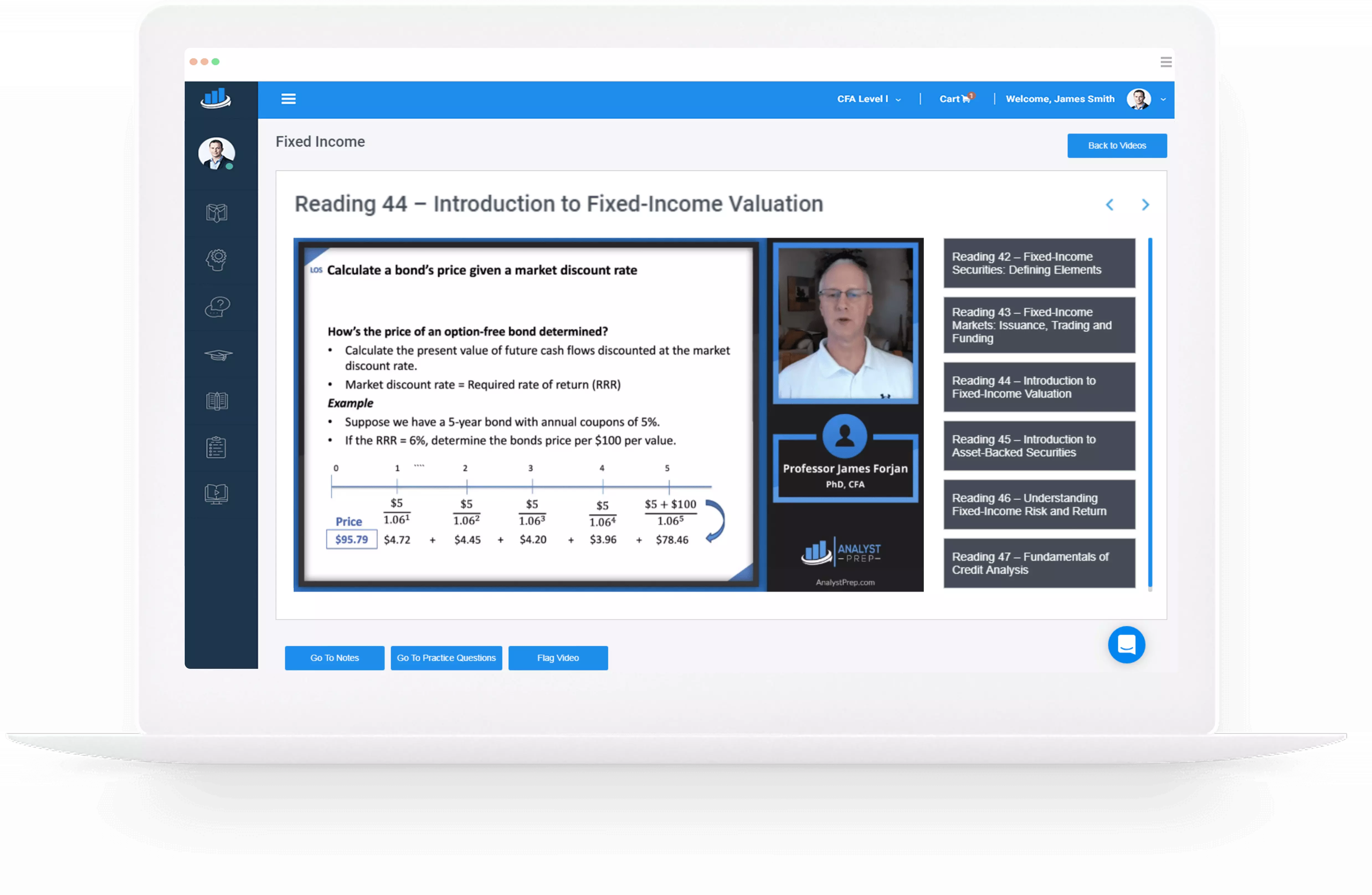
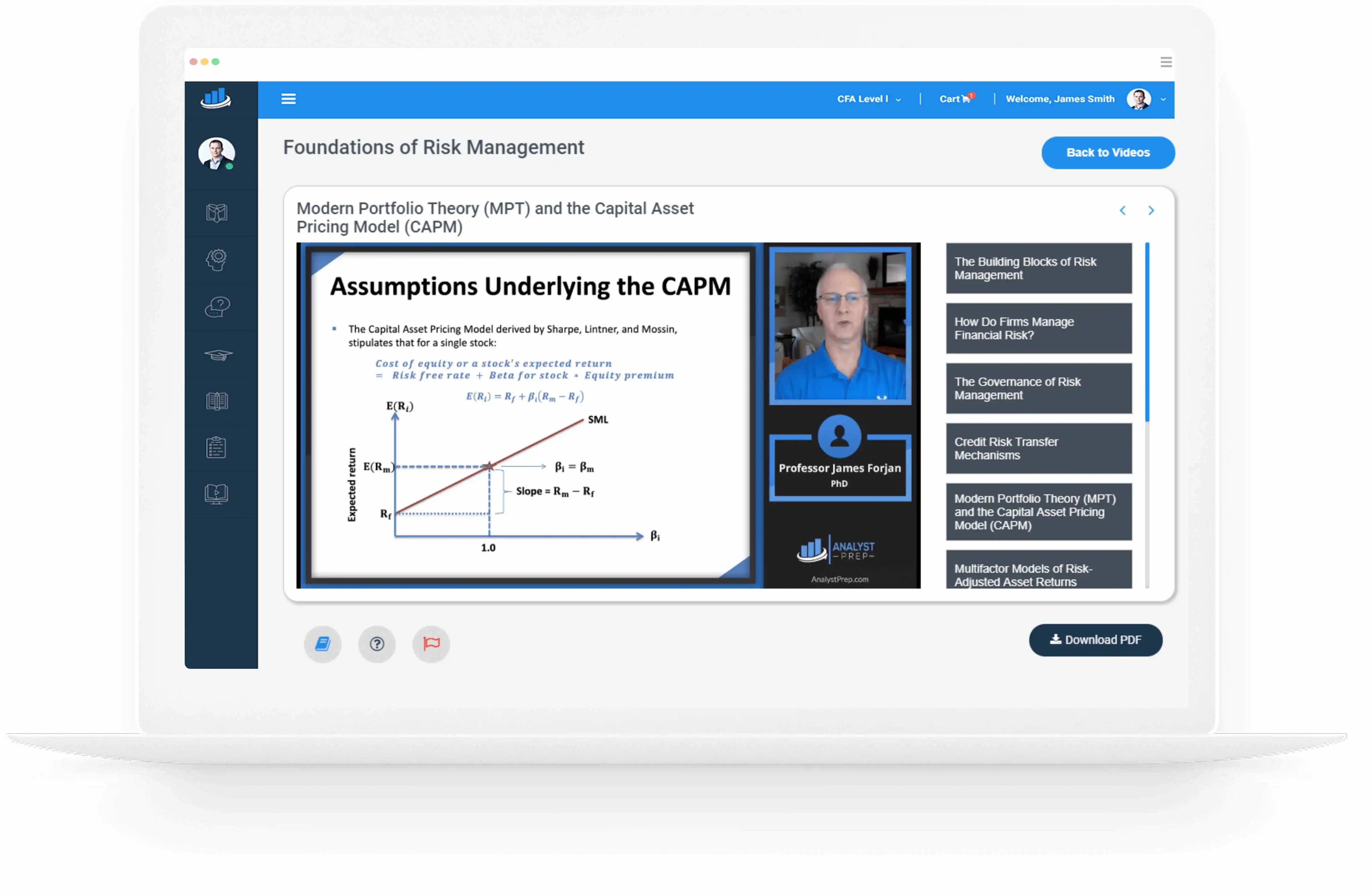
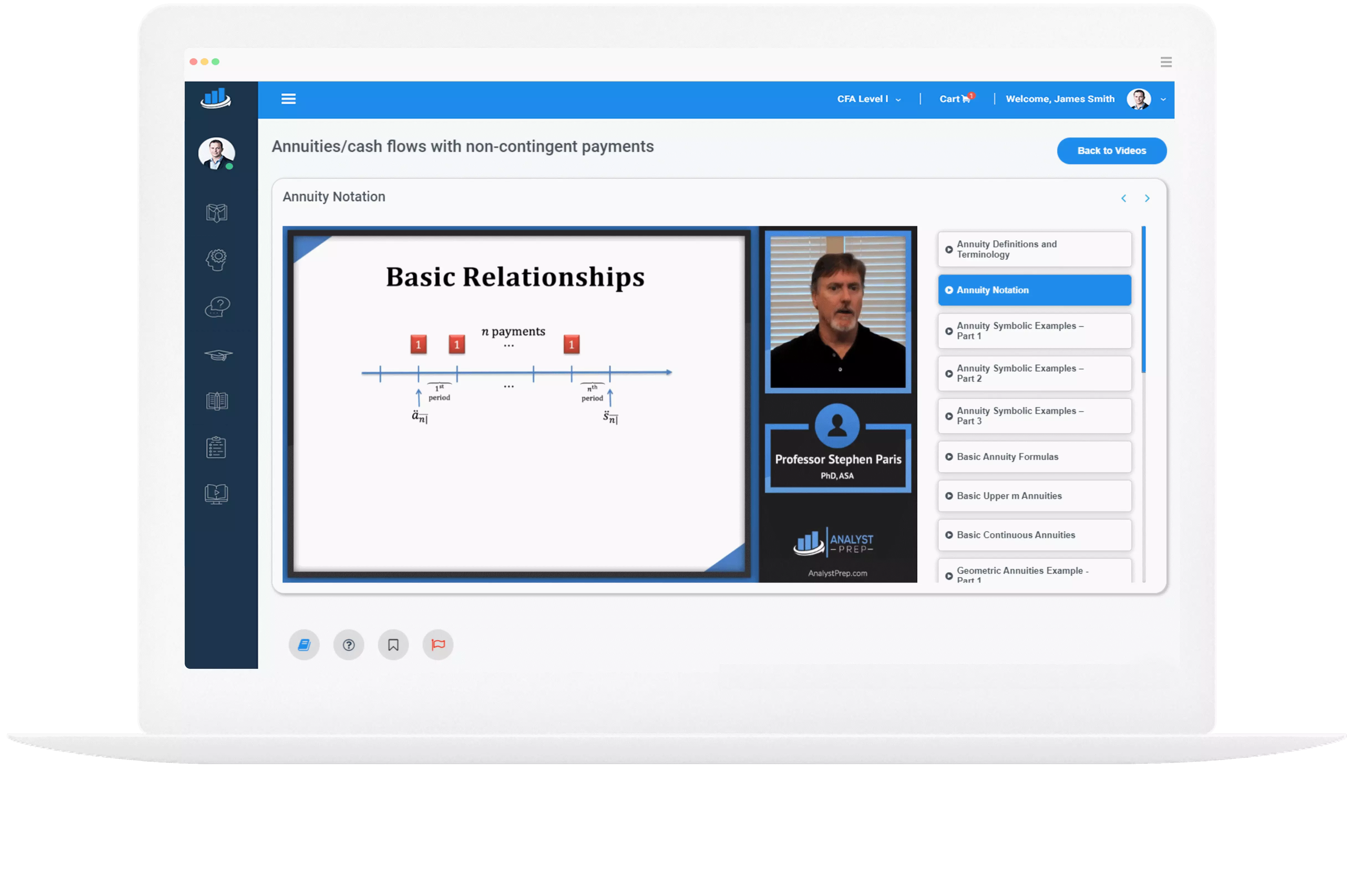
Some financial concepts and calculations are easier to understand when explained visually. Our video lessons provide additional explanations of challenging topics, helping you work through complex ideas and follow calculations step by step.
You can revisit these lessons whenever you need clarification or want to reinforce something you have already studied.
Our live classes provide an additional learning option for candidates who benefit from instructor-led explanations and structured learning sessions.
You can use these sessions to revisit challenging curriculum topics, follow worked examples and strengthen your understanding through guided instruction.
They can complement independent study by providing additional support when you need help understanding particular concepts.
Our AI Tutor is trained on our proprietary CFA curriculum content, including our study notes, video lessons and question bank.
This means its explanations are grounded in our own CFA learning materials rather than relying solely on general internet knowledge.
You can use it to explore difficult concepts, ask follow-up questions and obtain additional explanations while studying independently or reviewing challenging topics.
Our QBank allows you to put what you have learned into practice. Instead of waiting until you finish the entire curriculum, you can attempt questions immediately after studying individual readings or topics.
Reviewing the explanations helps you understand why answers are correct, identify knowledge gaps and determine which concepts require additional attention.
As your examination approaches, our mock examinations help you evaluate your preparation across the curriculum.
You can use them to practise under examination-like conditions, assess your performance, identify weaker areas and evaluate your time management.
Reviewing your results also helps you determine how to prioritize your remaining revision time.
By combining these resources, you can make better use of the hours available to you. Use our study notes and video lessons to learn, live classes and the AI Tutor for additional explanations, the QBank for regular practice and mock examinations to assess your readiness.
Use our study notes, video lessons, live classes, AI Tutor, QBank and mock exams to organize your preparation and make better use of your study time.
CFA Institute reports that successful candidates spend more than 300 hours preparing for each examination level on average. However, completing 300 hours does not guarantee a passing result. Your preparation requirements depend on your previous knowledge, learning pace and ability to apply the curriculum. Focus on understanding concepts, practising questions and evaluating your performance rather than relying exclusively on accumulated study hours.
Yes, it is possible to pass with fewer than 300 study hours because the benchmark is an average, not a mandatory minimum. Candidates with relevant academic backgrounds or professional experience may already understand some curriculum concepts. However, studying fewer hours is not a reliable shortcut. You should assess your understanding, practice performance and remaining knowledge gaps before deciding whether your preparation is sufficient.
The 300-hour benchmark is a useful starting point for planning CFA Level I preparation. However, your actual requirements depend on your familiarity with the curriculum, particularly subjects such as Quantitative Methods, Financial Statement Analysis, Economics and Fixed Income. Allocate sufficient time to understanding foundational concepts, learning formulas and practising multiple-choice questions. Adjust your schedule according to your performance.
You can use the same general 300-hour benchmark when planning for CFA Levels II and III. However, the preparation requirements differ because the examination formats and learning demands change. Level II requires considerable practice interpreting vignettes and applying valuation concepts, while Level III requires additional attention to portfolio management, item sets and constructed-response questions. Adjust your study allocation according to these requirements.
Your weekly study commitment depends on how much time you have before your examination. For example, completing 300 study hours over six months, or approximately 26 weeks, requires around 11.5 hours per week. A shorter preparation period requires more weekly study time. Choose a schedule that accommodates your responsibilities and allows sufficient time for learning, practice and revision.
Yes. Many candidates prepare for the CFA exam while maintaining full-time employment. You can distribute your study hours across weekday evenings and weekends, using shorter sessions during working days and longer blocks when you have more flexibility. The key is to establish a realistic routine that you can maintain consistently without neglecting revision and question practice.
Do not assume that you are automatically unprepared simply because you have not reached 300 hours. Evaluate your understanding of the curriculum, performance on practice questions, mock examination results and remaining knowledge gaps. If you are struggling with important topics, identify where additional preparation is needed. Consider your remaining time and available examination options before deciding how to proceed.
Make the most of your CFA study hours with our comprehensive study notes, practice questions, and video lessons. Build a structured study routine, track your progress, and strengthen your understanding of key exam concepts.
Offered by AnalystPrep
Get Ahead on Your Study Prep This Cyber Monday! Save 35% on all CFA® and FRM® Unlimited Packages. Use code CYBERMONDAY at checkout. Offer ends Dec 1st.
