




Company Competitive Strategy and Industry Position

Company Competitive Strategy and Industry Position

A company’s business model defines how it creates value. It includes its customers, products or services, key assets, and its network of suppliers and partners. This business model does not exist in a vacuum. It is directly shaped by the firm’s underlying competitive strategy. Every company operates with a competitive strategy, and they fall into two distinct categories:

  • Intentional Strategy – A deliberate plan that actively shapes the business model. It establishes measurable goals, communicates them clearly to internal teams and external investors, and tracks ongoing performance.
  • Unintentional Strategy – A passive approach where there is no deliberate planning. The company’s direction is accidentally dictated by managers pursuing their own personal incentives.

Companies’ stock prices reflect immediate market perceptions of value. True value creation can usually only be verified over time. Analysts examine three key factors when determining whether a company’s strategy will successfully create future investor value:

  1. Porter’s Five Forces. How effectively does the strategy protect and defend the firm against structural competitive pressures within the industry?
  2. PESTLE Analysis. Is the strategy aligned with macro-external forces, including Political, Economic, Social, Technological, Legal, and Environmental factors?
  3. Internal Execution. Does the firm possess the specific internal resources and capabilities required to execute its stated strategy?

Competitive Strategies for Startups, Growth Companies, and Firms in Decline

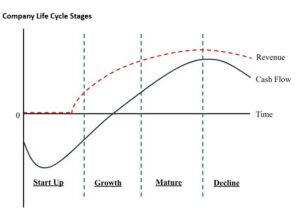
Firms are commonly categorized by their life-cycle stage. Competitive strategies, risks, and analytical focuses shift across the startup, growth, and decline stages of a company’s life cycle.
 

Startup Companies

Startups typically operate with little to no revenue, negative cash flows, and minimal assets. Their limited operating history makes historical financial analysis of limited value.

The primary objective for startup companies is to establish a viable business model by developing products or prototypes and demonstrating that they solve an unmet customer need.

Strategies heavily center on continuous innovation, forming strategic partnerships, and raising equity capital to fund research and development (R&D).

Startups face a very high level of operational risk and a steep likelihood of failure. They are vulnerable to constant setbacks as they try to survive.

Growth Companies

Growth firms have survived the initial phase, are transitioning toward profitability, and exhibit above-trend revenue and earnings growth. They often enter established markets via business model innovation, such as offering an existing product in a new, disruptive way to capture market share.

Analysts evaluate a growth firm’s revenue potential by breaking down its market size into three layers:

  • Total Addressable Market (TAM) – The absolute maximum revenue a company could generate if it captured 100% of the global market with no competitors.
  • Serviceable Market – The portion of the Total Addressable Market that fits a company’s specific product, pricing model, and geographic reach.
  • Obtainable Market – The realistic share of the serviceable market that a company can actually capture in the short term, given its current budget, scale, and competition.

Long-term growth relies on expanding beyond the initial obtainable market. This requires identifying demand drivers while overcoming operational, regulatory, and competitive hurdles.

Companies in decline

A company is considered in decline when its revenue is falling or growing at a pace below nominal GDP and that of industry peers. This shrinkage is usually accompanied by falling profitability and is driven by shifting consumer tastes, new product substitutes, or technological obsolescence. Declining industries suffer from excess capacity, which drastically intensifies competitive rivalry among remaining players.

The key strategy is to survive or wind down gracefully. Firms usually focus on:

  • Aggressive cost management and operational restructuring.
  • Downsizing or completely exiting underperforming business lines.
  • In some cases, attempting to reinvent weak business segments.

Firms in this stage are highly vulnerable to creative destruction, the process by which innovations render old products obsolete.

Whether a firm is an early-stage startup, trying to scale, or in decline, trying to downsize, the driving forces remain the same. Shifts in consumer demand and rapid technological development constantly reshape the competitive landscape.

Competitive Strategies for Established Companies

    1. Cost LeadershipThis strategy involves becoming the lowest-cost provider of goods or services across an entire industry. It is most prevalent in mature industries where products lack differentiation, and customers are highly price-sensitive, such as commodity processing and consumer staples.Mechanisms for Lowering CostEconomies of Scale & Scope. This involves increasing production volume to lower per-unit cost or leveraging existing infrastructure to distribute multiple products. For example, global soft drink manufacturers acquire independent bottlers and plug them into their massive, pre-existing distribution networks.

      Cost Control & Capacity Optimization. This involves minimizing overhead and maximizing the use of high-fixed-cost assets, such as budget airlines, by optimizing seat capacity and plane utilization.

    2. DifferentiationDifferentiation involves offering distinct product features, superior quality, unique brand positioning, or an enhanced customer experience that allows a firm to protect its market share.The strength of a differentiation strategy depends on how easily it can be copied. Legal protections like patents and copyrights offer long-term competitive moats, whereas easily replicated perks offer only short-lived advantages.A good example is using subscriptions to lock in steady, predictable revenue streams while closely monitoring consumer data to offer highly tailored incentives.
    3. FocusA focus strategy applies elements of cost leadership or differentiation, but targets a narrow, specific segment of the market, such as a specific geographic region, product mix, or customer niche rather than the broad industry.Differentiation focus involves specializing in a highly niche area with a unique product to command premium pricing. For example, a pharmaceutical company might narrow its business model entirely to research and development (R&D).

Cost focus involves seeking a competitive advantage by offering the lowest price within a highly specific, narrow market segment, such as IKEA, which uses a cost-focus strategy by designing affordable, flat-packed furniture for budget-conscious consumers, driving down prices by having them assemble the products themselves.

Understanding a company’s strategy helps analysts predict its future. Cost-based strategies provide a framework for projecting income statement and balance sheet efficiencies, while differentiation and focus strategies tie directly into specific revenue drivers and milestone tracking for equity valuation.

Question

A manufacturer of industrial chemicals has expanded production capacity across multiple product lines using a shared distribution network. Management’s primary objective is to reduce per-unit production costs while competing in an industry where customers purchase largely based on price. Which competitive strategy is the company most likely pursuing?

  1. Differentiation
  2. Cost leadership
  3. Differentiation focus

The correct answer is B.

The company is pursuing cost leadership. The industry is price sensitive, and management is lowering unit costs through economies of scale and scope by expanding production and utilizing an existing distribution network.

A is incorrect. Differentiation focuses on unique product features or brand value that justify premium pricing rather than minimizing production costs.

C is incorrect. A differentiation focus strategy targets a narrow market niche through unique offerings. The company is competing broadly across multiple product lines instead.

Start Free Trial →

Strengthen your understanding of competitive strategy, industry positioning, and company analysis in CFA Level I Equity with study notes, practice questions, and mock exams.


Shop CFA® Exam Prep

Offered by AnalystPrep

Featured Shop FRM® Exam Prep Learn with Us

    Subscribe to our newsletter and keep up with the latest and greatest tips for success

    Shop Actuarial Exams Prep Shop Graduate Admission Exam Prep


    Sergio Torrico
    Sergio Torrico
    2021-07-23
    Excelente para el FRM 2 Escribo esta revisión en español para los hispanohablantes, soy de Bolivia, y utilicé AnalystPrep para dudas y consultas sobre mi preparación para el FRM nivel 2 (lo tomé una sola vez y aprobé muy bien), siempre tuve un soporte claro, directo y rápido, el material sale rápido cuando hay cambios en el temario de GARP, y los ejercicios y exámenes son muy útiles para practicar.
    diana
    diana
    2021-07-17
    So helpful. I have been using the videos to prepare for the CFA Level II exam. The videos signpost the reading contents, explain the concepts and provide additional context for specific concepts. The fun light-hearted analogies are also a welcome break to some very dry content. I usually watch the videos before going into more in-depth reading and they are a good way to avoid being overwhelmed by the sheer volume of content when you look at the readings.
    Kriti Dhawan
    Kriti Dhawan
    2021-07-16
    A great curriculum provider. James sir explains the concept so well that rather than memorising it, you tend to intuitively understand and absorb them. Thank you ! Grateful I saw this at the right time for my CFA prep.
    nikhil kumar
    nikhil kumar
    2021-06-28
    Very well explained and gives a great insight about topics in a very short time. Glad to have found Professor Forjan's lectures.
    Marwan
    Marwan
    2021-06-22
    Great support throughout the course by the team, did not feel neglected
    Benjamin anonymous
    Benjamin anonymous
    2021-05-10
    I loved using AnalystPrep for FRM. QBank is huge, videos are great. Would recommend to a friend
    Daniel Glyn
    Daniel Glyn
    2021-03-24
    I have finished my FRM1 thanks to AnalystPrep. And now using AnalystPrep for my FRM2 preparation. Professor Forjan is brilliant. He gives such good explanations and analogies. And more than anything makes learning fun. A big thank you to Analystprep and Professor Forjan. 5 stars all the way!
    michael walshe
    michael walshe
    2021-03-18
    Professor James' videos are excellent for understanding the underlying theories behind financial engineering / financial analysis. The AnalystPrep videos were better than any of the others that I searched through on YouTube for providing a clear explanation of some concepts, such as Portfolio theory, CAPM, and Arbitrage Pricing theory. Watching these cleared up many of the unclarities I had in my head. Highly recommended.

    Get Ahead on Your Study Prep This Cyber Monday! Save 35% on all CFA® and FRM® Unlimited Packages. Use code CYBERMONDAY at checkout. Offer ends Dec 1st.




